
Selection
| Product | Centrifugal Fans |
| Blade types selected | Backward curved, backward inclined and radial tipped |
| Where it is used | All boiler applications for all industries: sugar, rice mill, pig iron plant, ferro alloy |
| Industries | Boiler, Sugar, Power, Iron & Steel, Non Ferrous Metal, Furnaces, Incinerators, Oil & Gas, Ceramic, Driers, Paper, Dyeing Industries |
Range
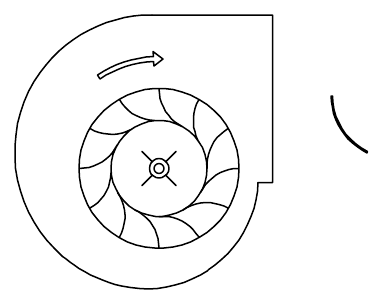
The inlet, impeller, volute, shaft and drive accessories work as one assembly. A change in duct resistance shifts the operating point on the fan curve, so a selected duty must state flow, pressure, gas density and speed together. The largest flow and pressure values in the range above are not a simultaneous guaranteed operating point.
In each industry
Boiler
A boiler house runs on draft. The FD fan pushes combustion air through the air heater into the windbox, the PA fan carries pulverised fuel from the mill to the burners, and the ID fan pulls the flue gas through the economiser, air heater and dust collector to the stack. The ID fan sees the worst duty: hot gas, fly ash and a pressure that rises as the filter loads. Bag filters or multiclones sit ahead of it, and silencers on the FD inlet keep the boiler house within noise limits.
Sugar
Sugar mills fire bagasse, a wet, fibrous fuel that produces a heavy fly ash load. The boiler fan set (ID, FD, SA and PA) is sized for bagasse's high moisture and the seasonal run, and the ID fan impeller is built for erosion. Wet scrubbers or multiclones clean the flue gas before the stack, and ventilation fans handle the heat in the mill house and pan floor.
Power
Thermal power stations use the full boiler fan set at the largest sizes: ID fans on the flue gas after the ESP, FD fans for secondary air, PA fans for mill air, and seal air blowers to keep pulverised coal out of the mill bearings. Coal handling plants add dust extraction fans on the crushers and transfer points, with bag filters and cyclones on the collected air.
Iron & Steel
Pig iron and steel plants need fans for the blast furnace stove, the sinter plant, the coke oven and the fume extraction over converters and electric arc furnaces. Combustion air blowers feed the stoves and reheating furnaces. Fume exhaust fans handle hot, dust-laden gas from the melt shop into bag filters. ID fans on the sinter strand and the boiler are built for abrasive dust and high temperature.
Non Ferrous Metal
Ferro alloy, aluminium and copper plants run submerged arc and reverberatory furnaces whose fumes carry fine metallic dust and, in some processes, acid gas. Fume exhaust fans pull the furnace gas into bag filters or wet scrubbers, ID fans handle the boiler and dryer gas, and combustion air blowers serve the furnaces. Stainless steel or lined construction is common on the scrubber side.
Furnaces
Heat treatment, forging and melting furnaces need combustion air blowers sized for the burner pressure, hot air fans for recirculation in the furnace chamber, and exhaust fans on the flue that can live with gas at several hundred degrees. Dilution air blowers bring the flue gas down to a temperature the filter can accept.
Incinerators
Waste incinerators need an ID fan that holds the furnace under draft through the quench, the scrubber and the bag filter, on gas that is hot, wet and corrosive. Dilution air blowers cool the flue gas, wet scrubbers take out acid gas, and adsorption towers on activated carbon remove dioxins and mercury before the stack.
Oil & Gas
Refineries and gas plants use fans on fired heaters and boilers (FD and ID), on flare and vent systems (vent silencers on relief and blow-down lines), and on process vessels where a knock-out drum separates liquid from vapour ahead of a compressor. Explosion-proof motors and spark-resistant construction are standard.
Ceramic
Tile, sanitaryware and refractory plants run spray dryers, kilns and glazing lines. Hot air fans recirculate kiln air, ID fans exhaust the kiln and spray dryer, and dust extraction fans with cyclones and bag filters clean the air from presses and glazing booths.
Driers
Rotary, fluid bed, spray and belt dryers all need a hot air fan to push heated air into the product and an exhaust fan to pull the moist, dust-laden air out through a cyclone or bag filter. The exhaust fan is sized at the hot, wet condition, and axial fans are used where the pressure is low.
Paper
Paper mills use fans in the dryer section hood (supply and exhaust of hot, humid air), on the boiler (ID, FD), and for fume and dust extraction in the pulp and finishing areas. Stainless steel construction handles the moisture in the hood exhaust.
Dyeing Industries
Dyeing and textile processing houses use fans on stenters and dryers (hot, humid exhaust), on the boiler, and for shop floor ventilation. Stenter exhaust carries oil mist and lint, so the fan and duct are built for cleaning access.
By process
The same duty, selected for the gas of each process.
Drive and construction
Offered direct mounted on the motor shaft, direct coupled, or belt driven. Material of construction follows the medium and temperature: mild steel, stainless steel, PP-FRP lined, MS FRP lined or MS rubber lined.
Testing and balancing
Performance tested as per IS 4894, BS 848 Part I, or as per customer standards. Rotors are statically and dynamically balanced to grade G 6.3 or G 2.5 as per ISO 21940-11.
Information needed to select or quote
- Duty point. Volume flow and static pressure at the fan inlet, with the gas density and temperature or the conditions to derive it.
- Operating conditions. Site altitude, normal operating temperature and continuous or intermittent duty.
- Gas stream. Dust loading and particle size, corrosive species, moisture, upset temperature and any tendency of the material to deposit on the impeller.
- Mechanical. Rotation viewed from the drive end, discharge orientation and motor power.