
Selection
| Product | Centrifugal Fans |
| Blade types selected | Backward curved and backward inclined |
| Industries | Iron & Steel, Non Ferrous Metal, Furnaces, Fertilizer, Glass, Ceramic, Driers, Paper, Tobacco, Tea, Food Processing, Automobile, Surface Coating, Dyeing Industries |
Range
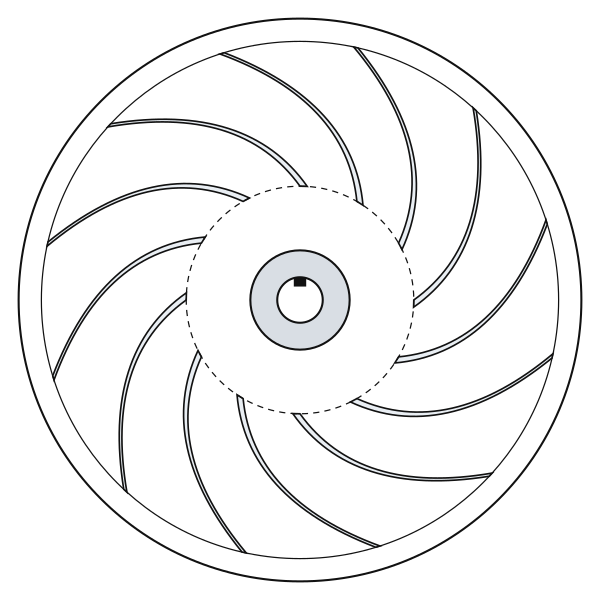
The inlet, impeller, volute, shaft and drive accessories work as one assembly. A change in duct resistance shifts the operating point on the fan curve, so a selected duty must state flow, pressure, gas density and speed together. The largest flow and pressure values in the range above are not a simultaneous guaranteed operating point.
In each industry
Iron & Steel
Pig iron and steel plants need fans for the blast furnace stove, the sinter plant, the coke oven and the fume extraction over converters and electric arc furnaces. Combustion air blowers feed the stoves and reheating furnaces. Fume exhaust fans handle hot, dust-laden gas from the melt shop into bag filters. ID fans on the sinter strand and the boiler are built for abrasive dust and high temperature.
Non Ferrous Metal
Ferro alloy, aluminium and copper plants run submerged arc and reverberatory furnaces whose fumes carry fine metallic dust and, in some processes, acid gas. Fume exhaust fans pull the furnace gas into bag filters or wet scrubbers, ID fans handle the boiler and dryer gas, and combustion air blowers serve the furnaces. Stainless steel or lined construction is common on the scrubber side.
Furnaces
Heat treatment, forging and melting furnaces need combustion air blowers sized for the burner pressure, hot air fans for recirculation in the furnace chamber, and exhaust fans on the flue that can live with gas at several hundred degrees. Dilution air blowers bring the flue gas down to a temperature the filter can accept.
Fertilizer
Fertilizer plants handle dust from granulators, dryers and coolers, and fumes such as ammonia and fluorides from reactors. Bag filters take the dust, wet scrubbers take the gas, and the fans behind them are built in stainless steel or lined construction. High pressure blowers serve the dryer and cooler drums.
Glass
Glass furnaces need combustion air at steady pressure, cooling air on the furnace structure, and high pressure blowers for forming and annealing. Fume exhaust from the regenerators is hot and carries batch dust, and goes to a bag filter with a dilution air blower ahead of it.
Ceramic
Tile, sanitaryware and refractory plants run spray dryers, kilns and glazing lines. Hot air fans recirculate kiln air, ID fans exhaust the kiln and spray dryer, and dust extraction fans with cyclones and bag filters clean the air from presses and glazing booths.
Driers
Rotary, fluid bed, spray and belt dryers all need a hot air fan to push heated air into the product and an exhaust fan to pull the moist, dust-laden air out through a cyclone or bag filter. The exhaust fan is sized at the hot, wet condition, and axial fans are used where the pressure is low.
Paper
Paper mills use fans in the dryer section hood (supply and exhaust of hot, humid air), on the boiler (ID, FD), and for fume and dust extraction in the pulp and finishing areas. Stainless steel construction handles the moisture in the hood exhaust.
Tobacco
Tobacco processing generates fine dust from cutting, drying and blending. Bag filter fans on the dust extraction system are the main duty, with cyclones as pre-collectors. Dryer exhaust and general ventilation complete the set.
Tea
Tea factories use hot air fans on the withering troughs and dryers, exhaust fans on the dryer outlet, and dust extraction on the sorting and packing lines. Trough fans are the characteristic duty: large volume, low pressure, long running hours.
Food Processing
Food plants need stainless steel fans for dryer and oven exhaust, dust extraction on milling and mixing with bag filters, and ventilation and AHUs that hold the processing area at the required temperature and air quality.
Automobile
Vehicle plants use fans on paint shop supply and exhaust, on ovens and dryers, on welding fume extraction, and for plant ventilation. Paint booth exhaust goes through wet scrubbers or adsorption towers for solvent; oven exhaust needs a hot air fan; the body shop needs fume extraction into bag filters.
Surface Coating
Painting, powder coating and galvanising lines exhaust solvent vapour, overspray and acid fume. Booth exhaust fans in stainless steel or FRP feed wet scrubbers or adsorption towers, ovens use hot air fans, and pickling tanks need fume extraction with mist eliminators.
Dyeing Industries
Dyeing and textile processing houses use fans on stenters and dryers (hot, humid exhaust), on the boiler, and for shop floor ventilation. Stenter exhaust carries oil mist and lint, so the fan and duct are built for cleaning access.
By process
The same duty, selected for the gas of each process.
Drive and construction
Offered direct mounted on the motor shaft, direct coupled, or belt driven. Material of construction follows the medium and temperature: mild steel, stainless steel, PP-FRP lined, MS FRP lined or MS rubber lined.
Testing and balancing
Performance tested as per IS 4894, BS 848 Part I, or as per customer standards. Rotors are statically and dynamically balanced to grade G 6.3 or G 2.5 as per ISO 21940-11.
Information needed to select or quote
- Duty point. Volume flow and static pressure at the fan inlet, with the gas density and temperature or the conditions to derive it.
- Operating conditions. Site altitude, normal operating temperature and continuous or intermittent duty.
- Gas stream. Dust loading and particle size, corrosive species, moisture, upset temperature and any tendency of the material to deposit on the impeller.
- Mechanical. Rotation viewed from the drive end, discharge orientation and motor power.