
Selection
| Product | Centrifugal Fans |
| Blade types selected | Backward inclined and forward curved |
| Where it is used | All industries including MEP |
| Industries | Sugar, Paper, Tobacco, Tea, Food Processing, Automobile, Surface Coating, Dyeing Industries, Tyre, Shipbuilding, Nuclear |
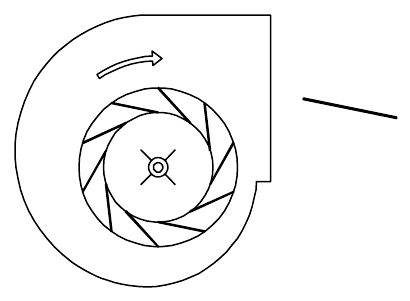
Range
The inlet, impeller, volute, shaft and drive accessories work as one assembly. A change in duct resistance shifts the operating point on the fan curve, so a selected duty must state flow, pressure, gas density and speed together. The largest flow and pressure values in the range above are not a simultaneous guaranteed operating point.
In each industry
Sugar
Sugar mills fire bagasse, a wet, fibrous fuel that produces a heavy fly ash load. The boiler fan set (ID, FD, SA and PA) is sized for bagasse's high moisture and the seasonal run, and the ID fan impeller is built for erosion. Wet scrubbers or multiclones clean the flue gas before the stack, and ventilation fans handle the heat in the mill house and pan floor.
Paper
Paper mills use fans in the dryer section hood (supply and exhaust of hot, humid air), on the boiler (ID, FD), and for fume and dust extraction in the pulp and finishing areas. Stainless steel construction handles the moisture in the hood exhaust.
Tobacco
Tobacco processing generates fine dust from cutting, drying and blending. Bag filter fans on the dust extraction system are the main duty, with cyclones as pre-collectors. Dryer exhaust and general ventilation complete the set.
Tea
Tea factories use hot air fans on the withering troughs and dryers, exhaust fans on the dryer outlet, and dust extraction on the sorting and packing lines. Trough fans are the characteristic duty: large volume, low pressure, long running hours.
Food Processing
Food plants need stainless steel fans for dryer and oven exhaust, dust extraction on milling and mixing with bag filters, and ventilation and AHUs that hold the processing area at the required temperature and air quality.
Automobile
Vehicle plants use fans on paint shop supply and exhaust, on ovens and dryers, on welding fume extraction, and for plant ventilation. Paint booth exhaust goes through wet scrubbers or adsorption towers for solvent; oven exhaust needs a hot air fan; the body shop needs fume extraction into bag filters.
Surface Coating
Painting, powder coating and galvanising lines exhaust solvent vapour, overspray and acid fume. Booth exhaust fans in stainless steel or FRP feed wet scrubbers or adsorption towers, ovens use hot air fans, and pickling tanks need fume extraction with mist eliminators.
Dyeing Industries
Dyeing and textile processing houses use fans on stenters and dryers (hot, humid exhaust), on the boiler, and for shop floor ventilation. Stenter exhaust carries oil mist and lint, so the fan and duct are built for cleaning access.
Tyre
Tyre plants generate carbon black dust in mixing, rubber fume in curing, and heat everywhere. Bag filter fans on the carbon black handling system, fume exhaust on the curing presses, and heavy ventilation across the plant are the main duties.
Shipbuilding
Shipyards need portable and fixed ventilation for confined-space work inside hulls and tanks, welding fume extraction, and exhaust for blasting and painting halls with dust collection and scrubbing.
Nuclear
Nuclear facilities use ventilation systems that hold the building under controlled negative pressure, with HEPA-filtered exhaust and AHUs on the supply side. Fans are specified for reliability and for filtration efficiency rather than for dust or heat.
By process
The same duty, selected for the gas of each process.
Drive and construction
Offered direct mounted on the motor shaft, direct coupled, or belt driven. Material of construction follows the medium and temperature: mild steel, stainless steel, PP-FRP lined, MS FRP lined or MS rubber lined.
Testing and balancing
Performance tested as per IS 4894, BS 848 Part I, or as per customer standards. Rotors are statically and dynamically balanced to grade G 6.3 or G 2.5 as per ISO 21940-11.
Information needed to select or quote
- Duty point. Volume flow and static pressure at the fan inlet, with the gas density and temperature or the conditions to derive it.
- Operating conditions. Site altitude, normal operating temperature and continuous or intermittent duty.
- Gas stream. Dust loading and particle size, corrosive species, moisture, upset temperature and any tendency of the material to deposit on the impeller.
- Mechanical. Rotation viewed from the drive end, discharge orientation and motor power.