
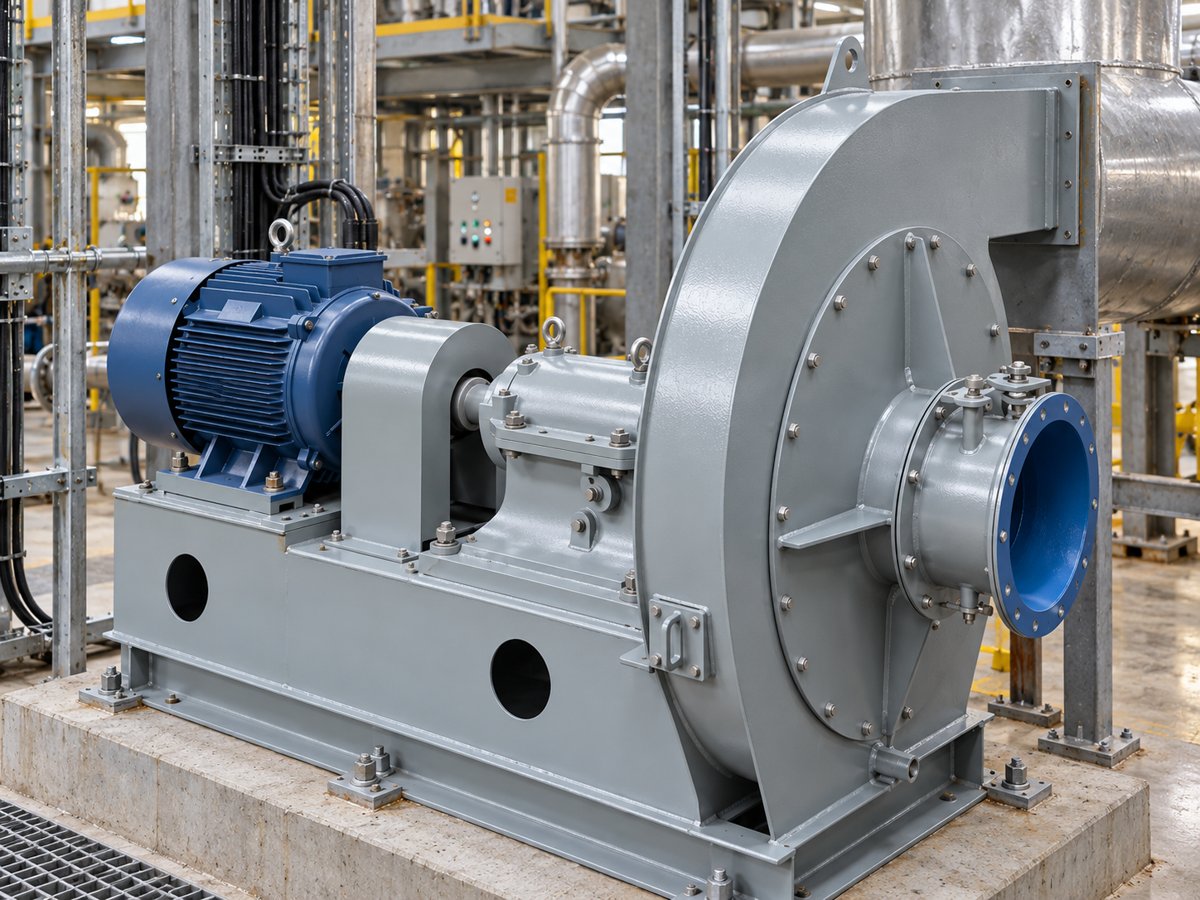
Selection
| Product | Centrifugal Fans |
| Blade types selected | Backward curved and radial tipped |
| Where it is used | All industries: glass, metallurgy, cement, fertilizer |
| Industries | Cement & Lime, Fertilizer, Glass |
Range
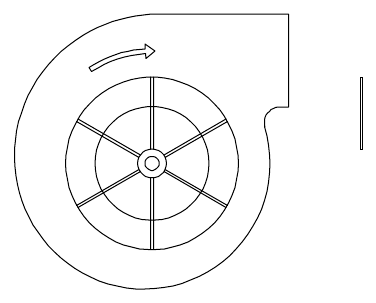
The inlet, impeller, volute, shaft and drive accessories work as one assembly. A change in duct resistance shifts the operating point on the fan curve, so a selected duty must state flow, pressure, gas density and speed together. The largest flow and pressure values in the range above are not a simultaneous guaranteed operating point.
In each industry
Cement & Lime
A cement line is a chain of fans. The preheater fan sets the kiln draft, the raw mill fan draws hot kiln gas through the mill to dry the meal, the cooler compartment fans blow air up through the clinker bed, the cooler vent fan exhausts the surplus, and the coal mill fan carries pulverised coal to the burner. Air slide blowers move meal and cement around the plant. Every one of these handles abrasive dust, so radial tipped and wear-protected backward curved impellers are the norm, with bag filters or multiclones on each exhaust.
Fertilizer
Fertilizer plants handle dust from granulators, dryers and coolers, and fumes such as ammonia and fluorides from reactors. Bag filters take the dust, wet scrubbers take the gas, and the fans behind them are built in stainless steel or lined construction. High pressure blowers serve the dryer and cooler drums.
Glass
Glass furnaces need combustion air at steady pressure, cooling air on the furnace structure, and high pressure blowers for forming and annealing. Fume exhaust from the regenerators is hot and carries batch dust, and goes to a bag filter with a dilution air blower ahead of it.
By process
The same duty, selected for the gas of each process.
Drive and construction
Offered direct mounted on the motor shaft, direct coupled, or belt driven. Material of construction follows the medium and temperature: mild steel, stainless steel, PP-FRP lined, MS FRP lined or MS rubber lined.
Testing and balancing
Performance tested as per IS 4894, BS 848 Part I, or as per customer standards. Rotors are statically and dynamically balanced to grade G 6.3 or G 2.5 as per ISO 21940-11.
Information needed to select or quote
- Duty point. Volume flow and static pressure at the fan inlet, with the gas density and temperature or the conditions to derive it.
- Operating conditions. Site altitude, normal operating temperature and continuous or intermittent duty.
- Gas stream. Dust loading and particle size, corrosive species, moisture, upset temperature and any tendency of the material to deposit on the impeller.
- Mechanical. Rotation viewed from the drive end, discharge orientation and motor power.