
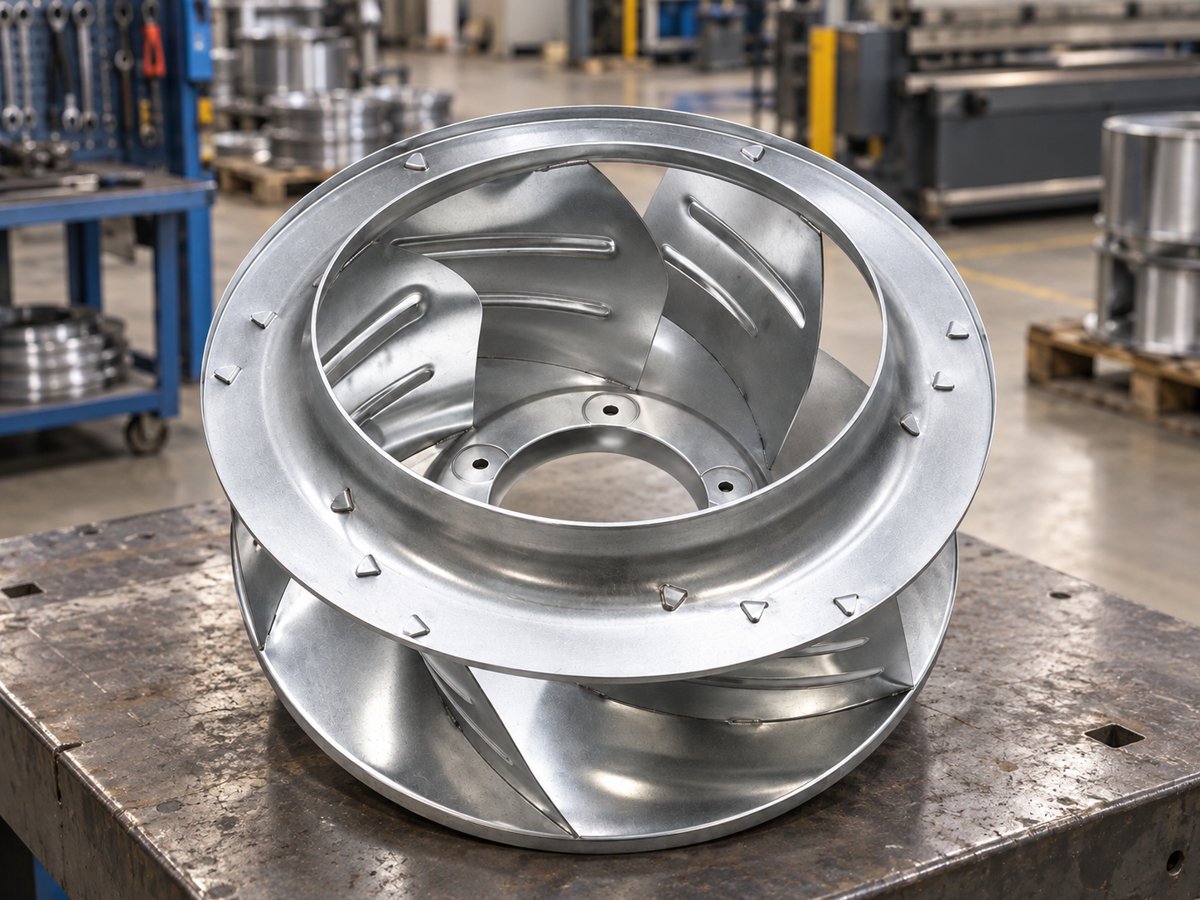
Blade geometry
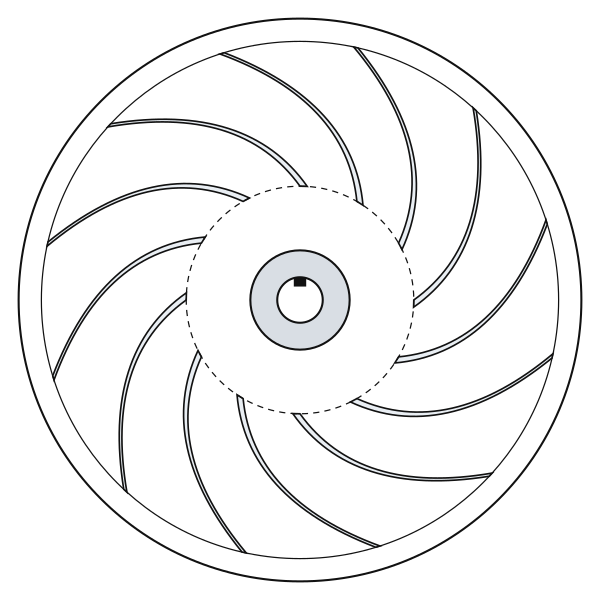
| Blade form | Backward, curved away from the direction of rotation |
| Exit blade angle | Below 90° |
| Number of blades | 6 to 18 |
| Air leaving the impeller | At a velocity less than the blade tip speed. The deep blade passages allow the pressure to develop within the impeller. |
Where it is used
- Clean air ventilation and process air supply
- Bag filter fans on the clean side of the filter
- Combustion air and FD duties on clean air
- High efficiency duties where operating power sets the running cost
Where the gas carries dust or scale, a straight radial or radial tipped impeller is the better selection. Backward curved blades are chosen for clean or lightly loaded airstreams.
Applications selected with this blade
| Application | What it does | Type usually selected |
|---|---|---|
| ID Fan | Sits at the outlet of a boiler, kiln or furnace and draws the flue gas through the plant to the stack. It handles hot, dust-laden gas at large volume, so it is sized at the hot condition and checked at cold start. | Backward curved, backward inclined and radial tipped |
| FD Fan | Supplies combustion air to a boiler or furnace, pushing ambient air through the air heater and into the windbox against the furnace draft. Clean air, so the blade is chosen for efficiency. | Backward curved and backward inclined |
| PA Fan | Supplies the air that dries the pulverised fuel in the mill and carries it to the burners. Runs at higher pressure than the FD fan because it must overcome the mill and the fuel piping. | Backward curved and radial tipped |
| SA Fan | Supplies the secondary combustion air that completes burning above the grate or around the burner. On bagasse and biomass boilers it also carries the over-fire air that controls the fuel bed. | Backward curved and backward inclined |
| Raw Mill Fan | Draws hot kiln gas through the raw mill and separator, drying the raw meal on the way and carrying the fine product to the collector. Heavy fine dust, so wear protection on the impeller is standard. | Backward curved and radial tipped |
| Cooler Vent Fan | Exhausts the surplus hot air from the clinker cooler after the secondary and tertiary air have been taken off, drawing it through the cooler dust collector. | Backward curved and radial tipped |
| Coal Mill Fan | Draws hot gas through the coal mill to dry and convey the pulverised coal to the burner or the fine coal bin. Built spark resistant because the gas carries combustible dust. | Backward curved and radial tipped |
| Bag Filter Fan | Pulls the process gas through the filter bags and discharges the cleaned gas to the stack. Works on the clean side, so the blade can be chosen for efficiency, with the filter pressure drop added to the duty. | Backward curved and radial tipped |
| Preheater Fan | Draws the kiln exhaust gas through the preheater cyclone stages. The largest fan in a cement line and the one that sets the kiln draft. | Backward curved and radial tipped |
| Cooler Compartment Fan | Blows ambient air up through the grate of the clinker cooler. Each compartment has its own fan set for the pressure that bed needs. | Backward curved and radial tipped |
| Air Slide Blower | Supplies low pressure aeration air to the fabric of an air slide, fluidising cement, raw meal or gypsum so it flows down the slide. | Backward curved and radial tipped |
| High Pressure Blower | Delivers combustion, aeration and conveying air where the system resistance runs to several thousand millimetres of water column in a single stage. | Backward curved and radial tipped |
| MVR Blower | Recompresses the vapour leaving an evaporator so it can be reused as the heating medium. Handles wet, often corrosive vapour, so wetted parts are in stainless steel. | Backward curved |
| Combustion Air Blower | Feeds a burner with air at the pressure the burner register needs. Sized for the burner turndown range, and often fitted with an inlet silencer. | Backward curved and radial tipped |
| Dilution Air Blower | Injects ambient air into a hot flue gas stream to bring it down to a temperature the downstream bag filter or fan can accept. | Backward curved |
| Cooler ID Fan | Draws the clinker cooler exhaust through the cooler dust collector to the stack, holding the cooler hood under a slight negative pressure. | Backward curved and radial tipped |
| Plug Fan | A centrifugal impeller without a scroll, plugged through the wall of an oven, dryer or air handling unit so it recirculates the air inside the chamber. Belt driven or direct driven from outside the hot zone. | Backward curved |
| Hot Air Fan | Circulates or supplies air at elevated temperature to a dryer, oven or kiln. Selected at the hot density with the shaft and bearing arrangement built for continuous hot running. | Backward curved and backward inclined |
| Seal Air Blower | Supplies clean air at a pressure above the mill or fan casing pressure to the shaft seals and bearing housings, so pulverised coal cannot enter. | Backward curved and radial |
| AHU | A packaged unit with fan, filters, cooling or heating coil and mixing box that conditions and delivers supply air. Pre, fine and HEPA filters as the air quality requires. | Backward curved and forward curved |
Industries
BoilerSugarPowerIron & SteelNon Ferrous MetalFurnacesIncineratorsOil & GasCeramicDriersPaperDyeing IndustriesCement & LimeCoal HandlingFertilizerGlassChemical & PharmaTobaccoTeaFood ProcessingAutomobileSurface CoatingNuclear
Drive and construction
Offered direct mounted on the motor shaft, direct coupled, or belt driven. Material of construction follows the medium and temperature: mild steel, stainless steel, PP-FRP lined, MS FRP lined or MS rubber lined.
Testing and balancing
Performance tested as per IS 4894, BS 848 Part I, or as per customer standards. Rotors are statically and dynamically balanced to grade G 6.3 or G 2.5 as per ISO 21940-11.
Information needed to select or quote
- Duty point. Volume flow and static pressure at the fan inlet, with the gas density and temperature or the conditions to derive it.
- Operating conditions. Site altitude, normal operating temperature and continuous or intermittent duty.
- Gas stream. Dust loading and particle size, corrosive species, moisture, upset temperature and any tendency of the material to deposit on the impeller.
- Mechanical. Rotation viewed from the drive end, discharge orientation and motor power.