
Blade geometry
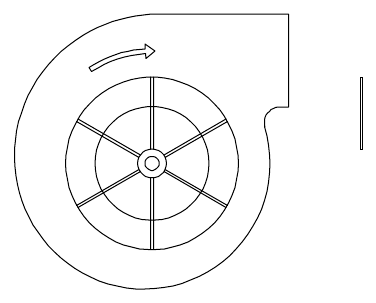
| Blade form | Radial to the shaft, straight |
| Exit blade angle | 90° |
| Number of blades | 6 to 12 |
| Air leaving the impeller | Radially, at a velocity close to the blade tip speed. The open blade passage does not hold deposit. |
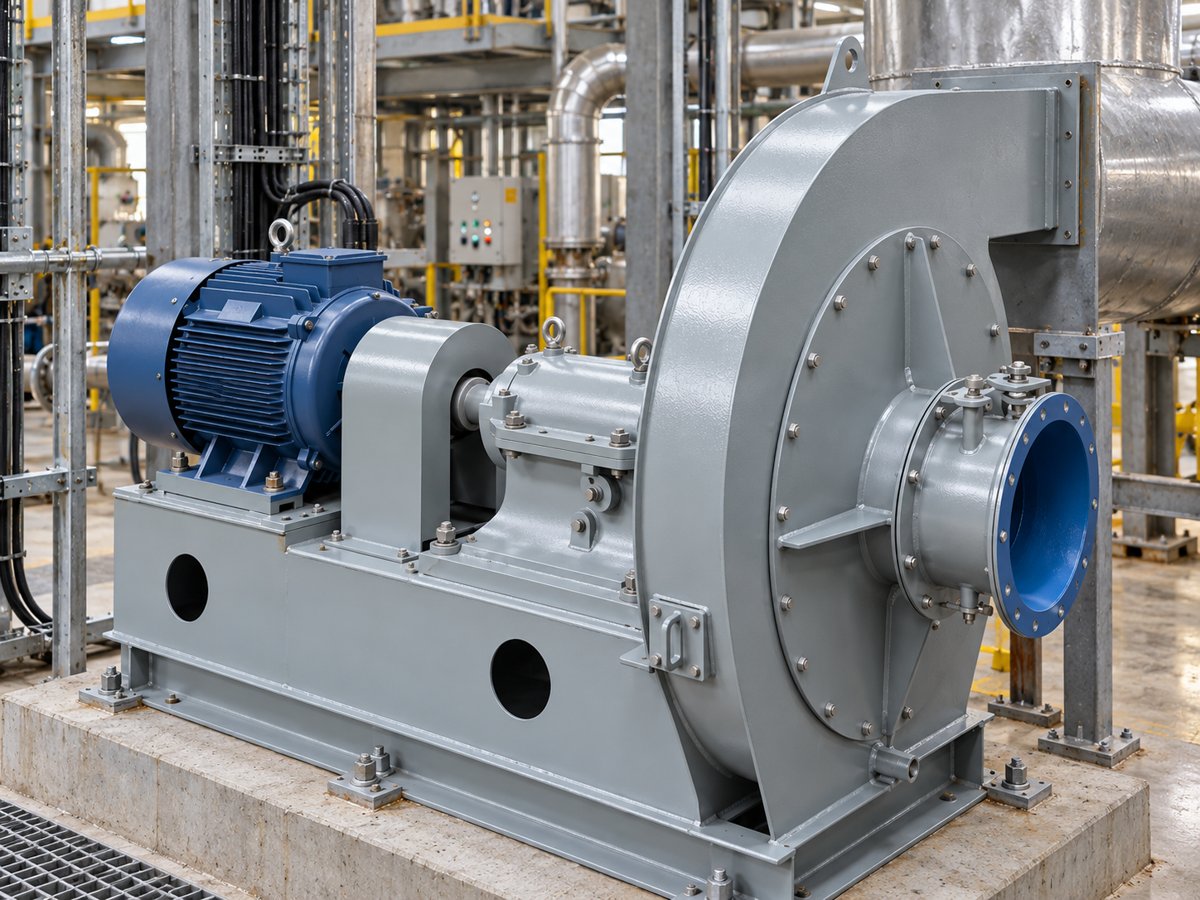
Where it is used
- Material handling and pneumatic conveying
- Dust-laden and dirty gas extraction
- Moderate to high pressure industrial duties
- Impellers that must be repaired or hard-faced at site
The least efficient of the centrifugal types, chosen where mechanical strength and a self-cleaning blade matter more than power. Blades can be coated or hard-faced to resist wear.
Applications selected with this blade
| Application | What it does | Type usually selected |
|---|---|---|
| High Pressure Blower | Delivers combustion, aeration and conveying air where the system resistance runs to several thousand millimetres of water column in a single stage. | Backward curved and radial tipped |
| Seal Air Blower | Supplies clean air at a pressure above the mill or fan casing pressure to the shaft seals and bearing housings, so pulverised coal cannot enter. | Backward curved and radial |
Industries
Drive and construction
Offered direct mounted on the motor shaft, direct coupled, or belt driven. Material of construction follows the medium and temperature: mild steel, stainless steel, PP-FRP lined, MS FRP lined or MS rubber lined.
Testing and balancing
Performance tested as per IS 4894, BS 848 Part I, or as per customer standards. Rotors are statically and dynamically balanced to grade G 6.3 or G 2.5 as per ISO 21940-11.
Information needed to select or quote
- Duty point. Volume flow and static pressure at the fan inlet, with the gas density and temperature or the conditions to derive it.
- Operating conditions. Site altitude, normal operating temperature and continuous or intermittent duty.
- Gas stream. Dust loading and particle size, corrosive species, moisture, upset temperature and any tendency of the material to deposit on the impeller.
- Mechanical. Rotation viewed from the drive end, discharge orientation and motor power.